InnSep

InnSep AS, Trondheim, Norway

One separator. Eight markets.

InnSep AS builds the Lynx separator, a rotating filter that takes liquid out of a gas stream without clogging and without added pressure drop. The same machine has protected compressor seals offshore, cleaned exhaust gas on ships, and taken grease out of commercial kitchen air.

See the eight value areasHow the separator works

Spun out of NTNU in 2011. Licensed to EagleBurgmann since 2015. Every claim on this site carries a year and a dated story in the archive.

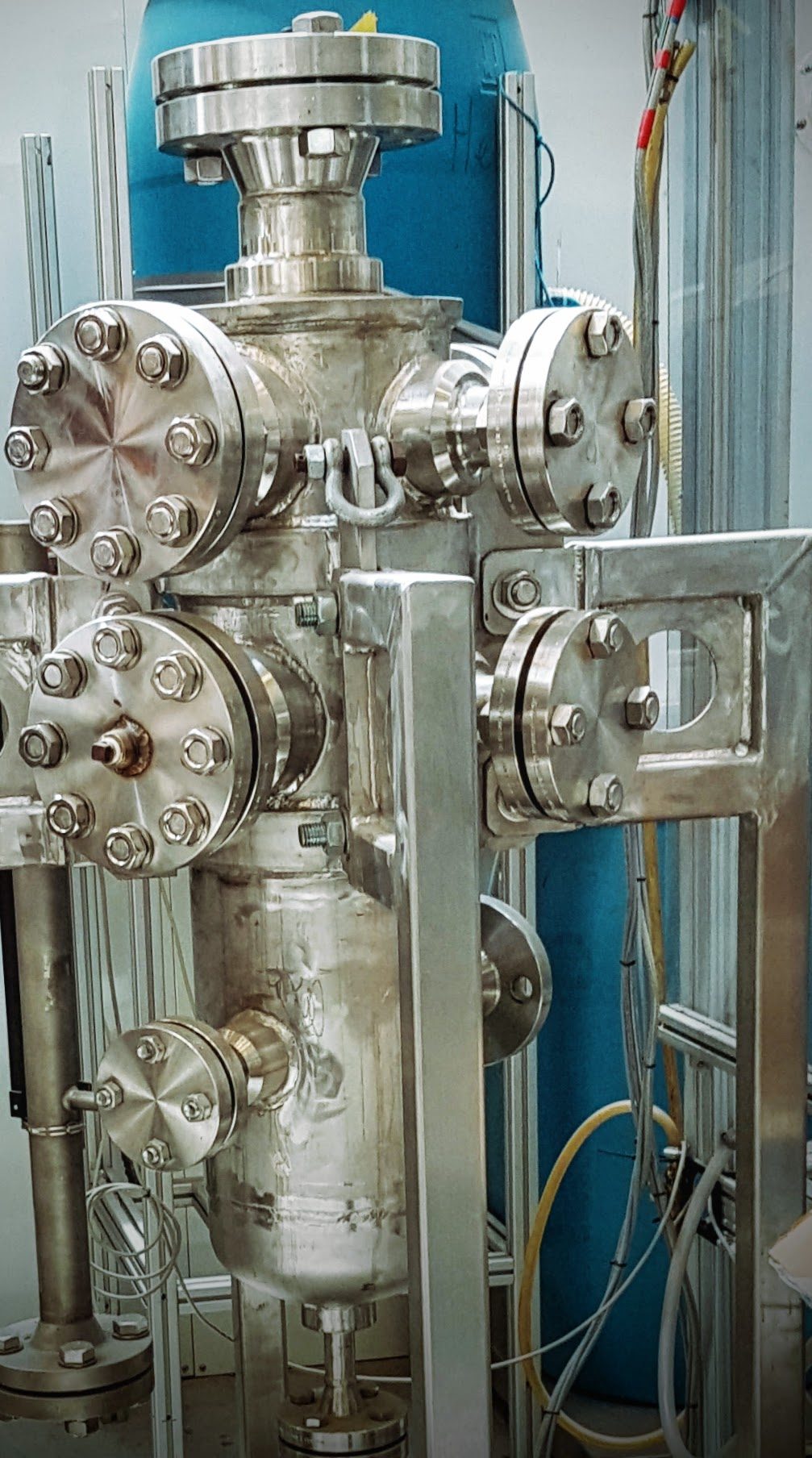
The Lynx 250 gas/liquid separator, a stainless steel pressure vessel with bolted flanges, rigged for high pressure testing in 2016.

The Lynx 250 separator, rigged for high pressure testing, 31 May 2016. Efficiency and K-factor were confirmed up to 90 bar.

2011

Spun out of NTNU in Trondheim

330 bar

Highest pressure test passed, 2016

0.3 micron

Smallest droplet separated in tests

4 of 8

Value areas that reached operation

On the record

Who has licensed, sold, funded or written about the Lynx separator

EagleBurgmann holds an exclusive licence for dry gas seal protection from 2015. Flebu International signed an exclusive sales agreement for ship exhaust gas recirculation in 2018. Innovation Norway, the Norwegian Research Council and the NTNU Discovery Fund funded the development. Chemical Engineering magazine covered the separator in October 2015.

EagleBurgmann logoFlebu International logoInnovation Norway logoChemical Engineering magazine logoNTNU

The technology

A filter that clears itself while it works

A conventional filter fills up. Pressure drop rises across it, and someone has to swap it. The Lynx separator turns, and the rotation clears the mesh continuously.

High speed footage of the Lynx separator, filmed by InnSep in 2013. The water is caught in the rotating mesh and flung outwards to the wall, which is what keeps the filter clear while it works.

The same principle is scaled to the duty. The Lynx 150 was built for very small liquid volumes, for dry gas seal protection. The Lynx 250 is the full gas/liquid separator used offshore and in commercial kitchens. The technology is patented.

Read the full technology page

Wet gas enters

A gas stream carrying liquid droplets enters the housing and meets a filter that is already turning. The housing is hermetically sealed, with no shaft passing through the wall.

Rotation clears the mesh

Droplets are caught in the mesh. The rotation throws the captured liquid outwards to the wall before it can build up, so the filter never fills.

Dry gas out, liquid drained

The liquid runs down into a separate chamber and is drained. The gas leaves dry, at the same pressure it would have had without the unit in the line.

Value areas

The same separator, eight different markets

Each area below carries the highest step it has reached and the year it reached it. Four areas were licensed or sold and put into use by another company. The spread is the honest picture, and it is what makes the four credible.

In operation (2016)

Dry gas seals

Protection of contact-free gas seals in offshore turbine compressors

EagleBurgmann took an exclusive licence in 2015 and put the unit into service in 2016, after a pressure test to 330 bar.

Verified in lab (2023)

Heat exchange

Preconditioning of ventilation air ahead of a heat exchanger

SkatteFUNN awarded R&D support in 2023 for a project on whether the Lynx principle can keep heat exchangers clean. InnSep carried the project out as applied for.

Concept (2022)

Microgravity

Separation without gravity, for spacecraft and habitats

InnSep described a separator design for weightlessness in 2022 and reached out to space organisations for collaboration.

Compare all eight value areas

Evidence

Two ducts, one kitchen hood, two years apart

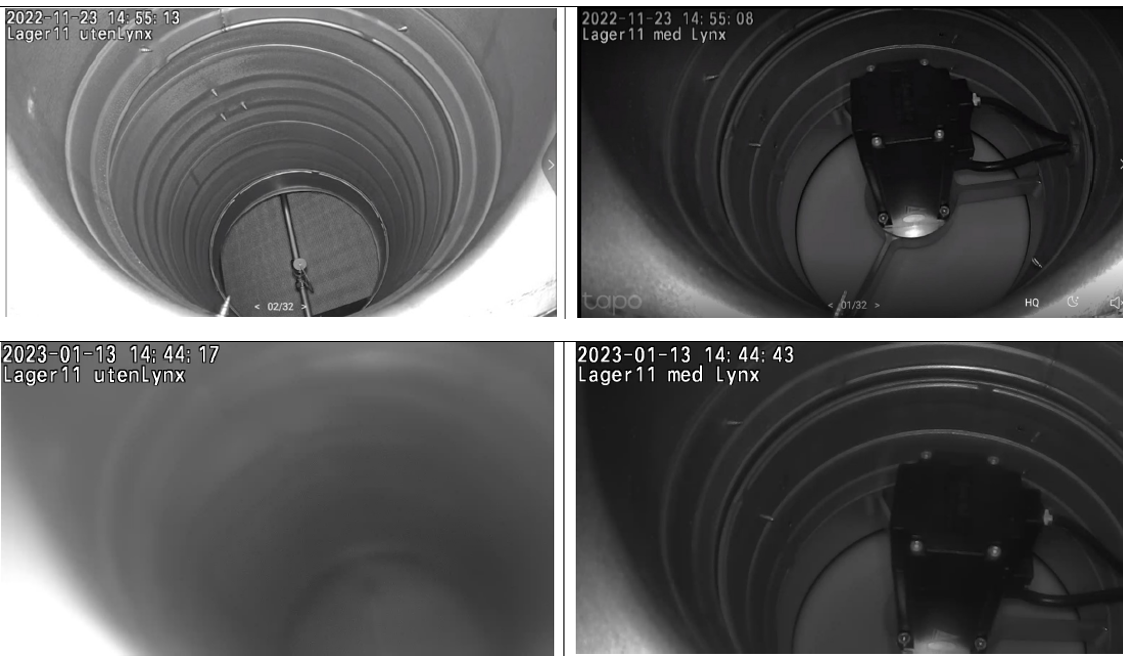
At the El Rincon restaurant in Trondheim, two ventilation ducts were fed from the same kitchen hood. One duct had a Lynx separator installed behind the hood filter. The other did not. Cameras recorded both.

The duct without a Lynx separator showed a clear grease deposit after six weeks. The duct with one showed no build-up and no detectable residue after two years of service, with no downtime. InnSep published the comparison on 24 May 2023.

Read the commercial launch story from 2023

Four camera frames inside kitchen ventilation ducts. The left column shows the duct without a Lynx separator, the right column the duct with one, recorded 23 November 2022 and 13 January 2023.
Camera frames from inside the two ducts. Left column without a Lynx separator, right column with one. Timestamps 23 November 2022 and 13 January 2023.

Openings

What InnSep is looking for

InnSep is opening the technology to partners and investors. The form is not fixed. It depends on the area, and on who is on the other side of the table.

The company would rather hear what you have in mind than tell you what is on offer. Start with a conversation.

Open now

Distribution for Lynx Kitchen in Sweden and Denmark

The kitchen separator has been sold and installed in Norway since 2023, and Tovenco carries it in Sweden today. Lynx Kitchen is looking for larger partners who can take it further, first in Sweden and Denmark.

The category does not matter. A contractor moving into commercial kitchens counts, and so does a seller who wants a larger share of the market and of the value chain.

  • You want to scale up.
  • You have a network in that market.

Lynx Kitchen is the contract party for the kitchen system.

Product facts and contact details are at lynxkitchen.com

Open now

Investors and partners in the seven other areas

The same separator has been licensed, sold and tested across seven other markets, from dry gas seals offshore to exhaust gas recirculation on ships. Each of them has a history, a year, and a source in the archive.

What an investor would buy is not settled. Shares, a stake in one area, or a licence are all open. That answer should come out of the first conversations, not out of an assumption made in advance.

  • You have looked at the areas and one of them fits what you do.
  • You want to talk about the form before it is fixed.

InnSep is the contract party for everything other than the kitchen system.

See all eight value areas

Next step

One line about which area interests you is enough to start. Call or write.

The site does not answer what a licence costs, what a share would be worth, or how royalties would work. Those belong in the conversation, where your own view of the model matters as much as ours.

Contact

The company

Fifteen years on one idea

InnSep AS is a spinout from the Department of Energy and Process Engineering at NTNU, the Norwegian University of Science and Technology in Trondheim. The company was established in 2011 to develop a scalable gas/liquid separator for removing droplets from a gas stream.

The Lynx concept was awarded the SMN1 Innovation Prize in 2011, nominated for the COMS Young Technology Award in 2012, and nominated for the Norwegian Tech Award in 2015. Development was funded by Innovation Norway, the NTNU Discovery Fund and the Norwegian Research Council.

The team

Who you would be talking to

Sondre K. Jacobsen

CEO

MSc Marine Technology, Oil and Gas, NTNU. Named as the contact for InnSep AS in the archive from 2016 onwards.

Roar S. Andersen

Chairman

MSc Chemical Process Engineering, Norwegian Institute of Technology. Former Senior Vice President of R&D at Statoil, Vice President Operations at Statoil, and Executive Vice President at SINTEF.

Questions and answers

Questions people ask about the Lynx separator

What is the Lynx separator?

The Lynx separator is a gas/liquid separator built by InnSep AS in Trondheim, Norway. It removes liquid droplets from a gas stream using a filter that rotates. InnSep AS was established in 2011 as a spinout from the Department of Energy and Process Engineering at NTNU, the Norwegian University of Science and Technology.

How does the Lynx separator work?

Wet gas passes through a filter that is turning. The mesh catches the liquid droplets, and the rotation throws the captured liquid outwards to the wall, where it drains into a separate chamber. Because the mesh is cleared continuously, it does not clog, and the pressure drop across the unit does not rise as it runs.

How is the Lynx separator different from a conventional gas/liquid separator?

A conventional separator relies on volume and gravity, and a static filter fills up over time. The Lynx separator uses rotation instead, so it takes 50 to 70 per cent less volume than comparable gas/liquid separators, and InnSep has reported separation down to 0.3 micron. At the Rotvoll test facility in 2016 the Lynx 250 lost less than a third of the efficiency a conventional separator loses as pressure rises to 90 bar.

Where has the Lynx separator been used?

In eight value areas. Four reached operation: dry gas seal protection on offshore compressors, licensed to EagleBurgmann in 2015; grease removal in commercial kitchens, launched in 2023; exhaust gas recirculation on ships, sold through Flebu International from 2018; and compressed air for seismic operations. The other four are at pilot, laboratory or concept level.

Has the Lynx separator been independently tested?

Yes. The Lynx 250 was tested at the Statoil high pressure test facility at Rotvoll in Trondheim in 2016, where efficiency and K-factor were confirmed up to 90 bar. The unit built for dry gas seal protection was pressure tested to 330 bar at EagleBurgmann Norway in 2016. The Lynx 250 is PED certified.

Who owns InnSep AS and where is the company based?

InnSep AS is a Norwegian company with its head office at Sluppenveien 11 in Trondheim, Norway. It was established in 2011 as a spinout from the Department of Energy and Process Engineering at NTNU, the Norwegian University of Science and Technology. Sondre K. Jacobsen is CEO and Roar S. Andersen is chairman.

What is InnSep looking for?

Two things. Lynx Kitchen is looking for distribution partners in Sweden and Denmark who want to scale up and have a network in that market. For the seven other value areas, InnSep AS is open to investors and partners. The form is not fixed, and the company would rather start with a conversation than with a term sheet.

Can the Lynx separator be retrofitted to an existing plant?

That is the main case InnSep has described. Because it needs 50 to 70 per cent less volume than a comparable separator, it fits where a conventional unit would not. In 2016 InnSep set out five retrofit positions: after a main separator, ahead of rotating equipment, in parallel for de-bottlenecking, as replacement internals, and as a replacement separator.
The archive

Forty-five dated stories, 2011 to 2026

The archive is the evidence behind every claim on this site. It has been kept since 2011, and the addresses have not moved.

🎉 We’ve Won!

We are proud to announce that our Kitchen separator Lynx Kitchen has been awarded VVS Project of the Year by NemiTek in the Trøndelag region. The jury highlighted the project as “a role model for energy-efficient and environmentally friendly solutions in commercial kitchen environments.” 🔧 What This

Read the full story
Sondre Jacobsen  ·  13 November 2025
Open the full news archive

Get in touch

Contact

Sondre Jacobsen

CEO, InnSep AS

+47 980 43 205
sondre@innsep.com

This is the contact route for InnSep. For the Lynx Kitchen system, go to lynxkitchen.com.