Technology
One separator, built around a rotating filter. Every value area on this site uses the same principle, in a different size and a different gas.
How the Lynx separator works
A gas stream carrying liquid droplets passes through a rotating filter. The filter catches the droplets. The rotation throws the captured liquid outwards to the wall, where it is drained off, and clears the filter continuously as it turns.
A static filter fills up. Pressure drop rises across it, and at some point it has to be swapped. The Lynx separator clears itself as it works, so it does not clog, and it adds no extra pressure drop over the process.
The housing is hermetically sealed. No shaft passes through it, so there is nothing to leak along and little to maintain.
Where it sits in the process
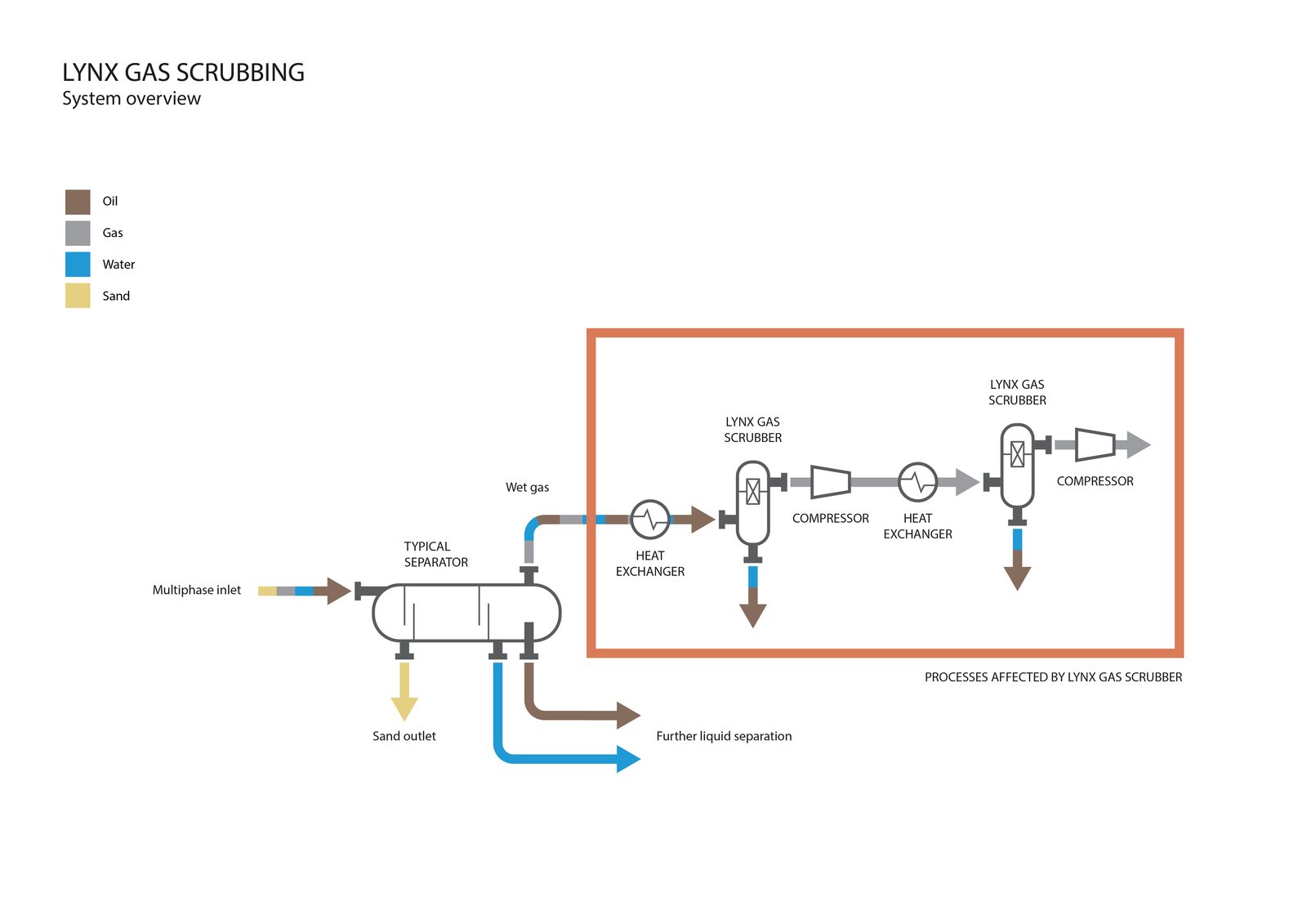
The Lynx separator removes the liquid that a conventional separator lets through. In a gas processing train it is placed ahead of each compressor, where carry-over liquid does the most damage.
Properties
- Compact. 50 to 70 per cent less volume than comparable gas/liquid separators.
- Separates droplets down to 0.3 micron.
- Low pressure drop, and no rise in pressure drop as the unit runs.
- Built to pipe code specifications.
- Hermetically sealed, with no shaft through the housing.
- Self cleaning, with the liquid collected in a separate chamber.
- Swapping internals is quick.
- High G-forces let it handle sticky substances that block conventional filters.
Where it is put to work
- De-bottlenecking an existing separator, in parallel
- Removing carry-over after a main separator
- Protecting rotating equipment ahead of a compressor
- Replacing the internals of a main separator, or the separator itself
- Handling high viscosity liquids
What has been tested
- Efficiency and K-factor confirmed up to 90 bar at the Statoil high pressure test facility at Rotvoll in Trondheim, in 2016. Conventional separators lose efficiency steadily as pressure rises. The Lynx 250 qualified at less than a third of that reduction.
- The Lynx principle was tested with hydrocarbons up to 60 bar at CEESI in the USA in 2012.
- The unit built for dry gas seal protection was pressure tested to 330 bar at Eagleburgmann Norway in 2016.
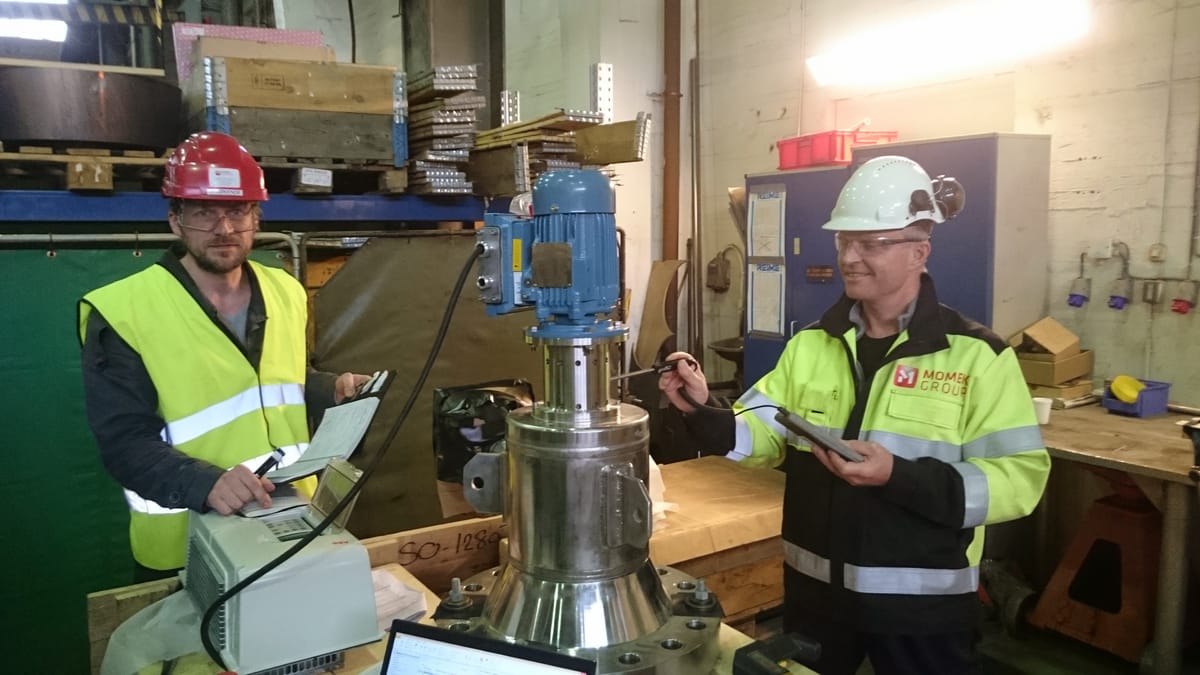
- The Lynx 250 is PED certified. The certification was carried out at MOMEK in May 2015.
- A CFD analysis of the Lynx separation process was completed in 2014, with Complex Flow Design AS and support from the RFFMIDT programme.
- The technology is patented.
Sizes and versions
The same principle is scaled to the duty. The Lynx 150 was built for very small liquid volumes, for dry gas seal protection. The Lynx 250 is the full gas/liquid separator used offshore and in commercial kitchens, and it handles 800 cubic metres per hour in the kitchen version.
For ship exhaust the design was drawn for outlets up to 6 metres in diameter. Units are placed in parallel where a single unit is not enough.
Where it came from
The Lynx separator came out of the Department of Energy and Process Engineering at NTNU in Trondheim. InnSep AS was established in 2011 to develop it.
InnSep was awarded the SMN1 Innovation Prize in 2011, nominated for the COMS Young Technology Award in 2012, and nominated for the Norwegian Tech Award in 2015 alongside five other Norwegian innovations.
Parts of the prototype were produced with Additive Technologies AS in Trondheim from 2015, using 3D metal printing and machining, with funding from the Norwegian Research Council.
Get in touch
Contact
This is the contact route for InnSep. For the Lynx Kitchen system, go to lynxkitchen.com.